We use cookies to improve our services. Read more about how we use cookies and how you can refuse them.
Two seas — five countries
Connecting the World Digitally
Proof-of-concept Pilot multimodal transport project under the cover of the Global Transit Document (dNet)


/mainpage/UNECE-Logo.png)
Consider the pilot projects initiated by TRACECA (Global Transit Document) and GUAM (GUAM-NET) using advanced blockchain technologies in their respective trade facilitation platforms as a positive development and contribution to development of Black Sea-Caspian Sea Transport Route and encourage TRACECA and GUAM enhance their alignment with UN/CEFACT semantic standards and reference data models in cooperation with UN ECE; continue their implementation and report the results at the next international seminar on trade and transport facilitation
Final recommendation by the UN ECE Seminar on trade facilitation and harmonization of multimodal data exchange, May 26-28. 2021
/mainpage/world.png)
Dear Mr Assavbayev, Mr Karimov and Mr Rounov,
...International integration, particularly in intercontinental supply chains, is at the core of the World Bank’s engagement with client countries in the field of freight logistics.
The World Bank is currently involved in several activities related to digitalization of multimodal systems linked to long distance freight and logistics worldwide.
Innovation and the adoption of digital tools are critical enablers on both fronts.
We, therefore, welcome the joint TRACECA, ICTD and ICRA concept of the Global Transit Document, which takes advantage of the latest technological developments.
Mr. Pablo Fajnzylber
On behalf of the President of the World Bank, Mr. Pablo Fajnzylber, Vice President
The World Bank, April 12, 2021
INTRODUCTION
Despite considerable efforts and massive capital investments in the basic transport infrastructure (ports, railways, roads) along the central section of the Ancient Silk Road, the transit potential of this transport corridor remains considerably underutilized.
Border closures and massive lockdowns due to the pandemic have demonstrated the vulnerability of Eurasian transport routes and the need for new approaches to ensuring the sustainable development of global supply chains.
The key to this new approach was indicated in the “Bucharest Statement” by the Ministers of Foreign Affairs of Azerbaijan, Georgia, Romania and Turkmenistan dated March 4, 2019. It called for “...promotion of BSCS (Black Sea-Caspian Sea) international transport route together with all interested states and international organizations, notably with the EU... “through wider implementation of digital technologies for simplification of export and import procedures and introduction of advanced information exchange systems.”lorem ipsun from kvorum doritos froggierom
Organizers
/mainpage/TRACECA.png)
TRACECA
is an international recognized programme, the members of which are 13 signatories of the “Basic Multilateral Agreement on International Transport for Development of the Europe-the Caucasus-Asia": The Republic of Azerbaijan, the Republic of Armenia, the Republic of Bulgaria, Georgia, the Islamic Republic of Iran, the Kyrgyz Republic, the Republic of Moldova, Romania, the Republic of Tajikistan, the Republic of Turkey, the Republic of Uzbekistan and Ukraine.
The Intergovernmental Commission TRACECA is a stable platform for bringing the interests together and finding the optimal ways to build mutually beneficial cooperation, as well as developing solutions in order to give momentum to the further development of TRACECA and close ties between its participants.
/mainpage/ICTD.png)
Internarional Centre for Transport Diplomacy
was created at the UN Headquarters in New York in the framework of the High-Level Roundtable on Sustainable Transport and Mobility to work with civil society, non-governmental institutions, educational institutions, government agencies, regional commissions and corporate executives as well as the UN and other multilateral institutions.
ICTD performs a variety of functions - from promotion of transit corridors and sustainable global trade, through the development of the Global Transit Document (GTrD) to Human Resources development by publication the first ever manual on Transport Diplomacy for universities, civil services and businesses.
/mainpage/ICRA.png)
The Intergovernmental Council of Road Administrators (ICRA)
was established in 1992. In 1998, the Heads of the CIS states gave the Council an intergovernmental status. The purpose of the ICRA is to promote the development and improvement of the road network, create conditions for a fuller use of the production, scientific and technical potential of the road organizations of the CIS, support governments in pursuing a coordinated road policy and deepening integration processes, improving the level of training, etc.
Participants
 JSC «KTZ Express», is a 100% subsidiary of the national company "Kazakhstan Railways" and provides a full range of transport services. JSC «KTZ Express» is a multimodal transport and logistics company which integrates rail, sea, air and road transport, port and airport infrastructure, as well as a network of warehouses and terminals.
 TULM OJSC was created in 2018 in order to effectively use the possibilities of international transport corridors passing through Turkmenistan, to help increase the volume of transit goods, and to develop logistics solutions for the delivery of transit, import-export cargo from the consignor to the consignee.
/mainpage/TojikVneshTrans.jpg)
/mainpage/logo ady container.png)
/mainpage/ADY Express.jpg)
Sponsors and Partners
/mainpage/logo-1.png) USAID is the world's premier international development agency and a catalytic actor driving development results. USAID's work advances U.S. national security and economic prosperity, demonstrates American generosity, and promotes a path to recipient self-reliance and resilience.
USAID is the world's premier international development agency and a catalytic actor driving development results. USAID's work advances U.S. national security and economic prosperity, demonstrates American generosity, and promotes a path to recipient self-reliance and resilience.
/mainpage/Emblem_of_Turkmenistan.svg.png)
/mainpage/kaz.jpeg)
/mainpage/gerb_Tajikist.jpg)
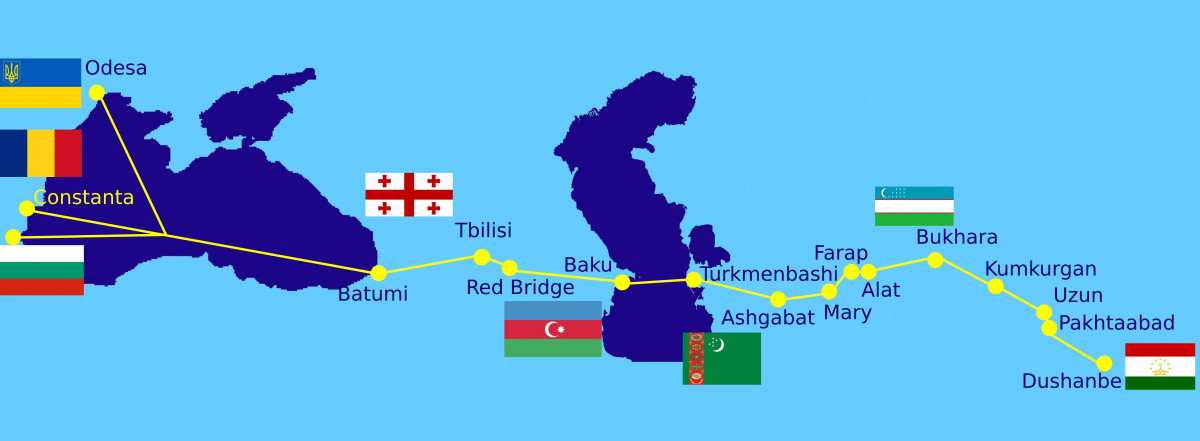
Route 1
“ East-West” (Tadjikistan-Uzbekistan-Turkmenistan-Azerbaijan-Georgia- EU)
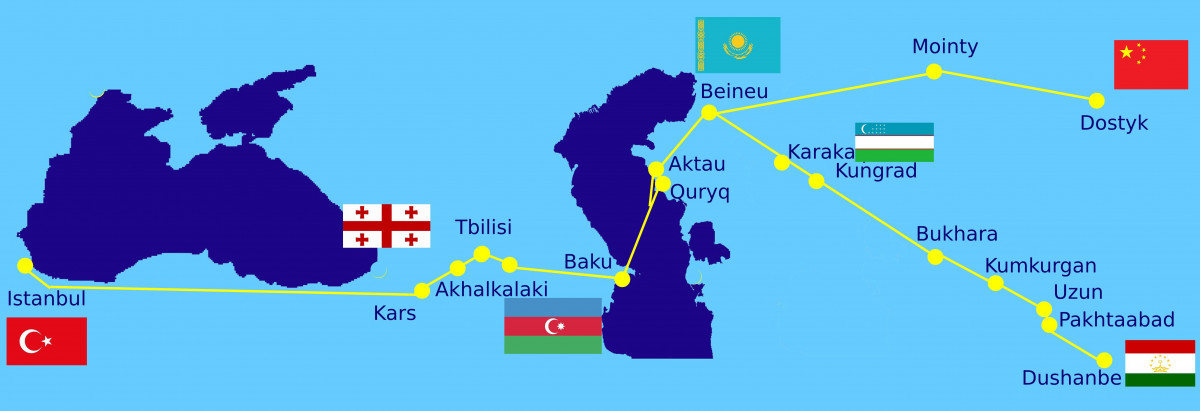
Route 2
«North-South» (Kazakhstan-Azerbaijan-Georgia-Turkey)
Testing state-of-art blockchain technologies
TradeLens is a highly secure data and document-sharing platform that simplifies and speeds your trade workflows. TradeLens provides a set of powerful, digital supply-chain visibility, collaboration and analytics tools developed with support from carriers, customs, banks and inland transport providers, and committed to rapidly growing an ecosystem of authorities, agents and transport providers that are connecting digitally to expedite global trade.
Organization
It is assumed that “2S5C” Pilot Project will be consecutively implemented in 2022-2024 in three stages:
Digital transit
1.
Operational phase - August-December 2022
Custom transit
2.
Operational phase – Second and Third quarters of 2023
Universal transit
3.
Operational phase - 2024
News




Expected results
We expect that on the outcomes of the Pilot Project, we will be able to achieve the following main results:
1.
give customs services access to the TradeLens platform, based on the latest scientific achievements and blockchain developments, and the ability of customs and other border services to work in a modern digital environment
2.
evaluate the ability of the TradeLens platform in real time to track the movement of individual containers from the starting point to the destination with an evaluation of corresponding risks
3.
evaluate TradeLens' ability to adapt its platform to the existing information systems currently used by customs services
4.
use TradeLens to optimize existing procedures and establish effective cooperation between customs services, port administrations, carriers and freight forwarders
5.
position the project participants among the world leaders in the introduction of advanced digital technologies in the management of transport and customs systems
6.
identify possible technological and infrastructure bottlenecks along the corridor in order to further eliminate them and reduce risks
7.
facilitate work on the harmonization and simplification of customs procedures in general
8.
increase the competitiveness and transit potential of TRACECA Transport Corridor and its sections - the Black Sea-Caspian Sea Transport Route and the Lapis Lazuli Transport Corridor (Lapis Lazuli) vis-a-vis the northern and southern routes of the Great Silk Road